Monets Coast
Imposing rock formations tower above the crashing waves of the Atlantic Ocean: the small town of Étretat on the Normandy coast delights visitors with its breathtaking natural scenery. Since the turn of the 19th century this rugged stretch of the French coastline has continued drawing artists and travellers. The once remote fishing village of Étretat gradually became a tourist destination and played a pivotal role in the birth of modern painting.
Renowned artists – from Eugène Delacroix and Gustave Courbet to Henri Matisse – translated their impressions of this wonder of nature into fascinating works of art. But it was Claude Monet in particular who best captured the transformation of Étretat itself: his vibrant and atmospheric Impressionist compositions bring the story of “Monet’s coast” to life.
“There is something for a painter to look at and for a poet to dream of!”
On sunny days, the tall cliffs gleam white in the light: located some thirty kilometres northeast of Le Havre, between the mouths of the Seine and the Somme, Étretat with its unique rock formations is a fabled destination.
Overtourism
Once a provincial backwater, Étretat is now overrun by unprecedented numbers of holiday-makers in the age of mass tourism. The already popular destination was recently featured in a hit TV series released by a streaming platform, prompting over a million extra visitors from all over the world to flock to the village of 1,200 inhabitants every year. The series is based on the much-loved stories about the gentleman thief Arsène Lupin, a classic character in French literary history. His creator, the writer Maurice Leblanc (1864–1941), built a villa in the heart of Étretat in 1918 and named it after his fictional hero. The desire of so many fans to immerse themselves in the world of their favourite series is overwhelming the small town and endangering the fragile coastal landscape. Since May 2025, access to the iconic rock arches has been largely closed due to severe erosion from human intervention.
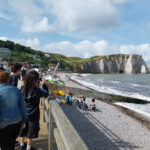
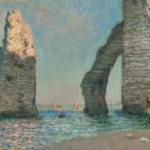
The play of light on the chalk cliffs of Étretat presents the visitor with an infinite variety of visual impressions: Porte d’Amont, Porte d’Aval and Manneporte – these are the names of the three mighty promontory arches that inspired many artists besides Claude Monet.
“If I had to show the sea to a friend for the first time, I would choose Étretat.”
Rugged Beauty
The beach of a charming fishing village, framed by distinctive cliffs: what Claude Monet’s painting captures in the bright colours and loose brushstrokes typical of Impressionism had already inspired the first visitors to Étretat at the end of the 18th century.
In 1883, Monet painted picturesque, colourful fishing boats against the backdrop of the Porte d’Amont. Around the same time, the writer Guy de Maupassant (1850–1893) compared the hump-ridged rock formation of the promontory northwest of Étretat to a “giant elephant dipping its trunk in the sea”.
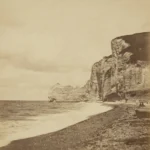
The mighty chalk cliffs have fascinated generations of artists: almost a century before Monet painted this picture, the first artists found their way to the remote coastal village. Their depictions of Étretat and its surroundings, produced at the end of the 18th century, heralded a cultural change: the experience of nature – the awed wonder at the beauty of the landscape – became a driving force behind making and appreciating art.
“I felt a strong desire to examine those works of Nature from above.”
Beautiful Rock
It is as if the artist Alexandre Jean Noël (1752–1843) had come to a sudden halt to take in a majestic view he had stumbled across of the Porte d’Aval, southeast of Étretat. The drawing from 1786 reveals a keen interest in the structural quality of the rock formations and the beauty of the coastal landscape.
First Image
Noël’s drawing is thought to be the earliest extant depiction of the bay of Étretat. In the 1780s, the small fishing village was still largely unknown by people from the city. For centuries, the forbidding northern coast had aroused more fear than curiosity.
Oyster Beds
Oyster beds can be seen in front of the Porte d’Aval rock. The much sought-after bivalves were matured in Étretat over several months and delivered to Paris overnight by horse-drawn cart. In fact, the drawing was anything but spontaneous and was commissioned by an oyster merchant for advertising purposes. Before the French Revolution, he spread the rumour that his seafood was consumed by none other than Marie-Antoinette herself.
A World in Transition
A time of momentous changes: over the course of the 19th century, the Industrial Revolution reshaped the social structures of Europe. As science and technology revolutionised many areas of life, people began to travel to and survey remote regions of the continent. At the same time, there was a growing desire to escape certain aspects of the newly industrialised world: the private experience of culture and nature increasingly came to be seen as a means of dreaming, relaxing and getting away from the deep social and political divisions of contemporary France. Since the French Revolution, republican and pro-democratic forces had been pitted against supporters of the monarchy, giving rise to several violent conflicts and failed coups. The proclamation of Napoleon III as emperor in 1852 (r. 1852–1870) marked the return of an authoritarian, monarchical state order.
Inspiring Views
Soaring cliffs and the roar of the sea – the natural spectacle of Étretat started attracting artists from all over Europe in the 1820s. The breathtaking coastline resonated with the zeitgeist and inspired awe, wonder and artistic creativity.
Picturesque Voyages
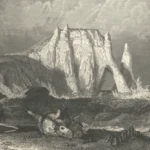
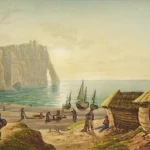
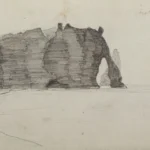
Picturesque Voyages
In the digital age, printed travel guides may seem a thing of the past – but in the early 19th century, they were just starting to enjoy a wide readership, with content that would be familiar to us today. Highly ambitious publications such as Voyages pittoresques had begun compiling the sights of France in the 1820s. As a result, hitherto obscure locations in Normandy were discovered as worthwhile and educational travel destinations. More and more people who could spare the time and money began taking a keen interest in exploring the cultural history and natural beauty of remote corners of Europe. In 1835, for example, the celebrated writer Victor Hugo (1802–1885) and his lover, the actress Juliette Drouet (1806–1883), travelled from Paris to Étretat – undeterred by the discomfort of what was then a two-day journey by stagecoach!
“What I saw at Étretat was admirable. (…) The [rock formation] is the most gigantic piece of architecture there is.”
He is credited with “discovering” Étretat: the Romantic marine painter Eugène Isabey (1803–1886) is thought to be the first artist to have spent any length of time in the coastal village, lodging with a former coastguard captain, around 1820. The successful painter played an important role in the growing popularity of the coastal destination.
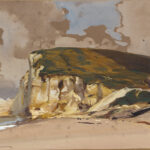
“One of the first strangers to visit this area was undoubtedly Monsieur Isabey, the famous marine painter.”
Marine Painter
Eugène Isabey was an immensely successful artist: during the July Monarchy (1830–1848), he was appointed court painter to King Louis-Philippe I, made a Knight and later an Officer of the French Legion of Honour. His focus on marine subjects – paintings of ships, cliffs and the open sea – was something he had inherited from his father, himself an influential artist and illustrator of Voyages pittoresques. The sea and coastal areas – along with overseas countries and foreign cultures – were particularly popular subjects in the 19th century. This cultural fascination went hand in hand with hard political realities: French foreign policy was fuelled by the desire for colonial expansionism and imperialism, which also had a direct impact on Eugène Isabey’s life. In 1830, the artist accompanied the French Invasion of Algiers. His depiction of the landing of troops on the Sidi-Fredj peninsula documents the start of French colonial rule in North Africa.
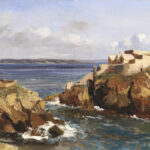
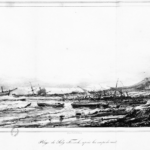
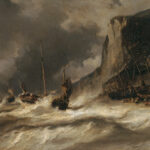
Isabey made his name with impressive views of the sea and coast. His Romantic paintings are full of pathos and drama. Romantic art reflects the sense of awe in the face of the mighty forces of nature.
Awe and Wonder
Awe and Wonder
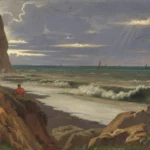
Mysterious, ancient rocks and the vast expanse of the ocean: Romantic paintings often convey a sense of overwhelming grandeur or immensity. Philosophers, writers and artists had been fascinated by this phenomenon since the mid-18th century. They used the term “sublime” to describe the humbling aesthetic force of something so great that it transcends the boundaries of the familiar and comprehensible evoking a thrilling sense of awe. Influential thinkers – from Edmund Burke to Immanuel Kant and Friedrich Schiller – agreed that it was this intense thrill of the sublime that allowed the individual to truly become aware of their place in the world.
“The wonders of the bold creation that the sea had wrought here, tearing rock from rock, shook my soul.”
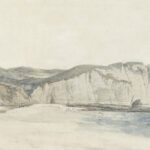
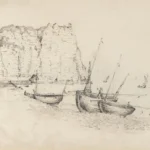
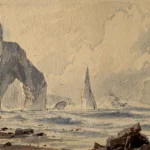
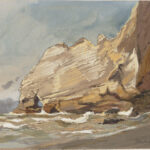
Awestruck views of the cliffs by the sea: Of particular note among Eugène Isabey’s numerous paintings of Étretat are his delicate watercolours. Circling the rock formations with a probing, inquiring gaze, the artist conveys his wonder at the mysteries of the visible world.
Geological History
The cliffs of Étretat rise to a height of between 75 and 84 metres! They were formed around 90 million years ago, in the Middle Cretaceous period, from the deposits of marine organisms: dark bands of hard flint run through the soft limestone walls. Tectonic forces – movements of the Earth’s crust – lifted the Normandy cliffs around two million years ago. The unique rock formations are the result of several interactive processes, ranging from the impact of sediment-laden waves to sudden temperature fluctuations and the weathering and erosion of the cliffs. In the 19th century, their striking appearance and geological origins captivated not only artists but also the world of science: the cliffs were mentioned in numerous non-fiction books and became a subject of study in the emerging disciplines of geology and mineralogy.
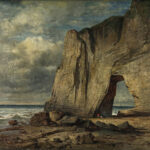
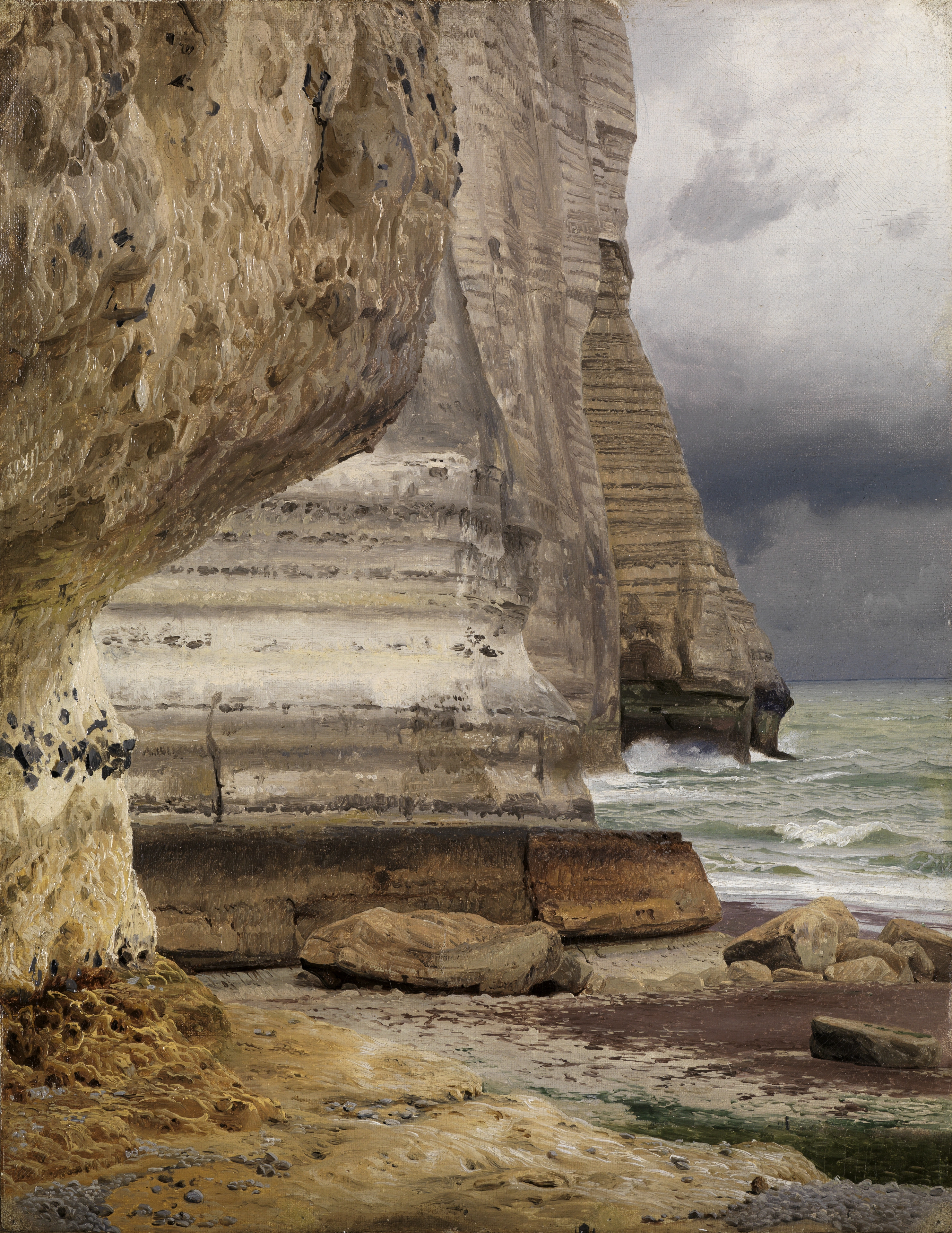
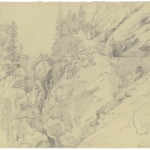
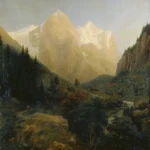
Artists approached the distinctive coastal landscape with a sense of wonder and intellectual curiosity: in 1836, the German painter Johann Wilhelm Schirmer (1807–1863) produced oil studies of the rocky coastline at Étretat. His paintings combine precise observation with a romanticised exaltation of what he saw. Even today, it is difficult to resist their stirring allure.
Romantic Artist
The cliffs of the Atlantic coast and the towering peaks of the Alps: Johann Schirmer was always on the lookout for spectacular landscapes. During his time as an assistant teacher – before he was appointed professor at the Düsseldorf Art Academy in 1839 – he travelled extensively throughout Europe, including a trip in 1836 from the Bernese Alps to Étretat and back. Schirmer worked en plein air – drawing and sketching outdoors in oils and watercolours, which allowed him to capture the immediacy of his response to nature. He used his studies when teaching students and as models for his monumental studio paintings of landscapes. Schirmer’s opulent paintings also found favour in France: in 1838 he was awarded a gold medal at the Paris Salon – arguably the most important annual art exhibition in Europe at the time.
“Étretat is an inexhaustible gold mine for painters. It is a veritable California that fills artists’ scrapbooks.”
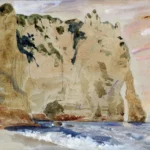
The most celebrated artists of the time were drawn to Étretat: in the 1840s, the influential French painter Eugène Delacroix (1798–1863) – a friend of Eugène Isabey – sketched the rock arches. His watercolour study of the Porte d’Aval translates the impression of nature into a processual, modern painterly idiom.
It is the harmony of colours that makes this landscape study so atmospheric. The artist’s use of varied brushstrokes reinforces the viewer’s sense that this is a highly personal, “felt” response to the evening mood. Delacroix’s brush drawing would later catch the eye of Claude Monet, who bought it for his own art collection in 1891. Perhaps he saw his predecessor’s work as a harbinger of Impressionism.
“I am crazy about the coast and the sea.”
Coastal Paradise?
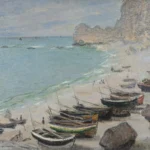
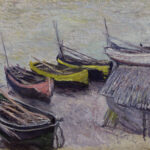
Old fishing boats on the beach act as a splash of colour against the turbid sea: Claude Monet’s Impressionist play of colours has lost none of its eye-catching power. At the same time, his painting Boats on the Beach at Étretat speaks to a sense of nostalgia that was widely felt in the 19th century. The rise of smoky industrial centres and rapidly expanding cities fuelled a desire to return to nature and a simpler, more authentic way of life. This, in turn, fuelled the popularity of places like Étretat, changing it from a remote fishing village and artists’ haunt into a fashionable seaside resort.
With a few dynamic brushstrokes, Monet also captures a strange kind of hut: it is a caloge, a decommissioned fishing boat converted into a thatched beach hut. The fishermen of Étretat used it to store their nets, buoys and ropes.
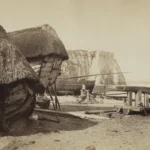
From makeshift utility hut to Normandy tourist attraction: in some places, caloges now serve as beach cafés. By the time Monet painted his Boats on the Beach at Étretat in 1883, these distinctive huts had already become recognised local landmarks for the swelling numbers of visitors to the coast around Étretat.
“Étretat is becoming more and more ravishing (…) the beach with all these fine boats is superb.”
Modern Tourism
Travelling purely for the sake of travelling and out of curiosity, with no professional purpose whatsoever: what may seem perfectly normal to us today only emerged as a social phenomenon in the 19th century. In 1872, Émile Littré’s landmark dictionary of the French language traced the term “touriste” back to the English tradition of the Grand Tour. This elite, educational rite of passage had brought young men of the British (and northern European) upper classes to the cultural centres of Europe since the 17th century and is indeed considered the precursor to modern tourism. In the 19th century, travel ceased to be the preserve of the aristocracy. It was democratised and became an emerging industry: the advent of the railways and steamships made health resorts, spas as well as scenic and cultural attractions more accessible. The English entrepreneur Thomas Cook (1808–1892) invented the package holiday. From the 1840s onwards, he offered complete travel packages to the English coast, France, Germany, Italy and even Egypt – all-inclusive for anyone with the time and money to spare.
Summer Resort
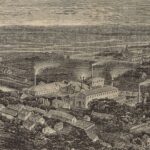
A remote fishing village comes into easy reach: in 1838, the first road leading to Étretat was constructed, followed a few years later by road connections from Fécamp in the north and Le Havre in the south, and in 1890 by a railway line from Paris. The face of Étretat gradually changed: summer villas sprung up, owned by wealthy city dwellers, and public seawater baths and a casino were built along the beach.
“Since 1820, when Isabey began to explore Étretat (…), they have been coming in their hundreds every summer.”
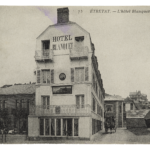
Hôtel Blanquet, the oldest inn in the village, had long been considered an insider tip among artists and writers. By the mid-19th century, it was dubbed “Au Rendezvous des Artistes” and became popular with summer visitors as well. In 1842 – as the village was beginning to change – the successful Parisian painter Eugène Le Poittevin (1806–1870) painted a wooden sign for the hotel’s façade.
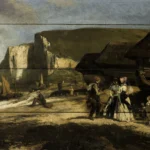
The chalk cliffs form the backdrop to the bustle of fishermen on the beach. Also featured are the distinctive caloges and an artist sketching as he gazes out to sea. In the foreground of the wooden sign, two elaborately dressed townswomen attest to the dawn of tourism. Le Poittevin’s sign advertises what summer visitors to Étretat could expect: the beach, the cliffs and encounters with the local villagers.
Eugène Le Poittevin
Eugène Le Poittevin (1806–1870) may be largely forgotten today, but during his lifetime he was one of the best-known artists in Paris. Having studied at the renowned École des Beaux Arts, he enjoyed considerable success at the Salon, the academy’s annual exhibition platform. A painter of large marines – scenes of naval battles and coastal landscapes – Le Poittevin also worked as a lithographer and caricaturist, gaining notoriety for his erotic and political satires. In 1849, he became one of the first urbanites to acquire a plot of land in Étretat, at the Porte d’Aval, where he built a house and studio. In his villa “La Chaufferette” (the brazier), built in 1858 in the village centre, he became a generous host to artists, writers, actors and composers visiting Étretat.
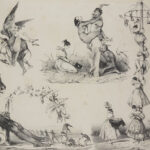
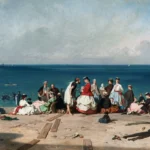
Eugène Le Poittevin spent a great deal of time in Étretat and was friends with the local population. A keen observer of the village’s transformation, he captured the activities of summer visitors on the beach with subtle irony in a large painting completed in 1864.
A Day by the Sea
A portrait of society: summer visitors in elegant attire! Approaching his subject with a touch of humour, Le Poittevin captures women embroidering and reading, men gesticulating, and children playing. Even the pooches of the Parisian elite seem to be enjoying the fresh sea air and deep-blue water. In 1864, when the painting was created, the number of summer visitors to Étretat had already increased rapidly – the 1,500 permanent residents were now joined every year by approximately 4,000–5,000 guests.
Swimming Writer
The young man in a bathing suit is probably Guy de Maupassant (1850–1893), who would become one of the most renowned French writers of the 19th century. Born in a chateau in Normandy, Maupassant spent his summers in Étretat with his mother and is said to have been a very good swimmer. The painter depicts the athletic 14-year-old in lively conversation with two summer visitors.
Bathing Service
On the far right of the painting, Le Poittevin depicts the Étretat swimming baths. In front of the changing cabins, a self-conscious bather is intent on rushing past a woman carrying a flat basket. The artist stages a clash between two worlds: the encounters between an urbanite summer guest and a villager. The woman’s tanned, weather-beaten skin betrays her hard physical labour in the open air.
Take a Dip!
City dwellers are braving the sea! What we now take for granted as one of the pleasures of summer was new and exciting in the 19th century. Bathing in the cold waters of the Atlantic Ocean initially served medical purposes and was prescribed by doctors as a cure for various ailments. But people soon discovered their enthusiasm for bathing for its own sake: Le Poittevin’s painting shows the bourgeoisie frolicking merrily in the water. Bathing attendants and boatmen ensure the safety and comfort of the summer visitors.
Belching Steamboat
Heavy, grey clouds of smoke on the horizon – a mighty steamship ploughs through the English Channel. With this detail, the painter reminds us of the dramatic changes of his time: industrialisation and its technological innovations did not stop at the coastline. In 1838, the French navy began replacing all its sailing ships with steamships.
Who’s Who
A few of the faces in the panorama of beachgoers are recognisable portraits: the man reading a newspaper with a dog at his feet is Charles Albert d’Arnoux (1820–1882), an aristocrat, caricaturist and pioneering photographer and an acquaintance of Le Poittevin. Étretat attracted several celebrated creative minds, among them the writers Victor Hugo (1802–1885), Alexandre Dumas (1802–1870), Gustave Flaubert (1821–1880), the composer Jacques Offenbach (1819–1880), the actress Eugénie Doche (1821–1900) and the operatic baritone Jean-Baptiste Faure (1830–1914).
Fishing Gear
A fishing net, a buoy and a woven basket – the objects in the foreground of the beach panorama reveal more than meets the eye: the fishermen’s everyday tools counterbalance the children’s toys and the heap of casually strewn clothes of the summer guests. The artist highlights the social disparities that modern tourism throws into sharp relief, with abundance, leisure and financial clout colliding with archaic simplicity, physically demanding labour and poverty.
SEA BATHING
The third seaside resort in France! Following the first seaside swimming baths in Dieppe and Trouville further along the coast, the Bains Duchemin opened in Étretat in 1843–1844. From Normandy, the model of sea bathing would soon spread to other coastal regions of France. Initially, saltwater bathing served therapeutic purposes: in English coastal towns such as Brighton and Scarborough, patients had already started taking to the chilly waters in the 18th century. These bathing cures were based on the miasma theory – the medical belief that diseases were caused by noxious air or foul vapours. Cold sea water was thought to have healing properties. In the second half of the 19th century, the miasma theory fell out of favour, and sea bathing gradually became a popular leisure activity.
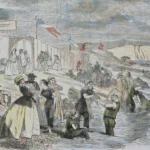
“[The women brought] utter chaos to the quiet life of Étretat. They made the pebbles tremble beneath the frou-frou [rustle] of their dresses.”
Étretat Through the Camera Lens
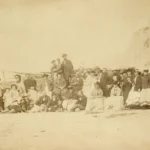
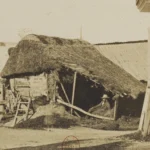

Étretat Through the Camera Lens
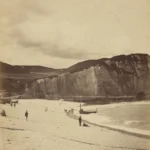
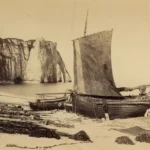
Today, holiday photos are taken digitally, with little forethought or effort. In the mid-19th century, however, analogue photography was barely a few decades old and not many people could claim to have mastered its technical challenges. The new technology arrived in Étretat in the 1850s. Wealthy visitors took numerous photographs of their summer resort, capturing holidaymakers and boats on the beach, traditional fishermen’s huts, the cliffs and the village. Amateur photographers such as Paul Gaillard (1832–1890) and the chemist Alphonse Davanne (1824–1912) created entire series of images and were founding members of the Société française de photographie in 1854, the world’s first photographic club.
A profound change: the local population of Étretat adapted to the needs of summer visitors. People who had been fishermen, weavers or merchant-navy sailors at the beginning of the 19th century took to working as domestic servants, gardeners or bathing attendants. But visitors to Étretat continued to harbour a nostalgic dream of “untouched” nature and a traditional existence living off the sea and the land.
The Dream of Untouched Authenticity
Despite all the changes, Étretat’s image as a remote, unspoilt coastal village remains intact. Ever since the area was first discovered by artists, the fishermen and villagers in particular have served as a blank canvas for the projected fantasies and hackneyed ideas of city dwellers.
“In Étretat, everything has a strangeness that forcefully strikes the imagination.”
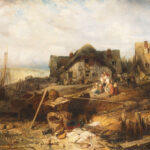
A village and its inhabitants, far away from modern society: Eugène Isabey didn’t just paint the breathtaking coastline of Étretat. His painting Beach at Low Tide of 1833 is marked by Romanticism’s desire for a simple life spent in harmony with nature. It shows the houses and people of the village before it was spoiled by tourism.
Family Idyll?
A poor fisherman’s closely knit family of many children, dressed in simple clothes, bathed in a soft light: the painting conveys a touching, if idealised image of a close community “uncorrupted” by modern industrial life. For locals, life in Étretat could be very harsh indeed: hunger and regular floodings that buried the village in mud were part of the struggle for survival.
Thatched
Wind-swept, thatched half-timbered cottages stand close together, straw projects from the windows, and everyday objects lean against the walls. Although Isabey’s painting hints at the harsh poverty of the fishermen, it is infused with a dreamy longing for cosy homeliness. In reality, the old thatched cottages of Étretat were built close to ground level, their walls made of hewn flint.
On the Ground
Baskets, old fishing gear and a pile of freshly caught rays lie scattered haphazardly across the rocky beach: this detail of the painting alludes to the idea of the “uncivilised”, down-to-earth nature of the fisherman’s existence. The sophisticated city dwellers’ view of the simplicity of coastal life fluctuated between romanticisation and disdain. The viewers and buyers of this picture could feast their eyes on it and still feel aloof from the life it captures.
Life in Poverty
It was not only visual artists who captured the life of Étretat’s longtime residents. Writers also took an interest in the circumstances of the fishermen and cottage workers in the coastal village. Besides Eugène Isabey, Alphonse Karr (1808–1890) played a key role in raising Étretat’s profile. In 1850 he published his Histoire de Rose et de Jean Duchemin, a diary-like account of a cottage labourer and fisherman’s wife from Étretat. The book reveals a life marked by hardship, poverty and deep piety – and no less than sixteen hungry children whose stomachs were forever rumbling.
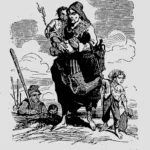
Long after tourism had arrived, Eugène Le Poittevin painted numerous pictures of the fishermen of the coastal community. The paintings depict hard-working people marked by poverty, set against the breathtaking natural spectacle of the cliffs of Étretat.
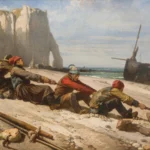
Four fishermen in patched clothing are dragging a boat onto the beach. In the background, another group of men are pulling with all their might on a capstan winch to haul an even heavier boat out of the water. The artist paints the fishermen of Étretat as faceless figures: only the man with the blue, white and red cap in the foreground shows his face, deeply furrowed by exertion and constant exposure to the elements. Like Le Poittevin’s panoramas of summer visitors on the beach, his paintings of fishermen contain a hint of social critique.
Red Caps
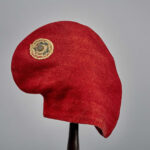
Fishermen close to the shore or farther out, foraging for shellfish at low tide – in all his paintings, Le Poittevin depicts men wearing striking red caps. Such caps were part of the traditional costume of fishermen from nearby Dieppe. At the same time, they would have reminded contemporary viewers of one of the most potent political symbols of 18th- and 19th-century France: the bonnet rouge, or Phrygian cap. During the French Revolution, this cap – mistakenly believed to be the headwear of freed slaves in antiquity – became a symbol of liberty and democratic ideals. Le Poittevin’s paintings were created under Napoleon III. He had proclaimed himself Emperor of the French after a coup d’état in 1852 and put an end to France’s fledgling republican constitution until the collapse of the Second Empire in 1870.
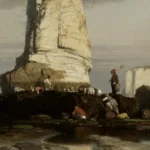
Tourism reveals social divisions: around 1860, the beach of Étretat was divided into two. The northern section, with its beach promenade lined with villas and the casino, was strictly reserved for bathers. The southern section, facing the Aval cliffs, remained the domain of fishermen and washerwomen and was known by the derisive name Perrey des Manants (“pebble dump of the simpletons”).
“Étretat languishes (…). This brush with Paris, fashionable Paris, however well it pays, is a scourge on the land.”
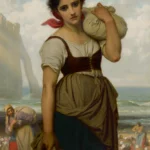
A seductive image of a beautiful young woman: in 1869, the Parisian artist Hugues Merle (1822–1881) portrayed a laundress in front of the iconic Porte d’Aval – at first glance, a Romantic, sumptuous painting that reinforces the clichéd image of Étretat’s unspoilt nature. But on closer inspection, the laundress’s slight frown betrays the drudgery of her existence, from which there is no escape. The hard-working older women in the background seem to presage her future fate.
Washerwomen on the Beach
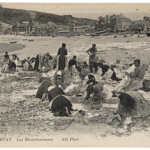
Washing laundry on the beach? In Étretat, this had been common practice for centuries: at low tide, freshwater springs are exposed beneath the pebble beach and allow for the washing of clothing and linens. Embodying the supposedly unspoilt authenticity of the place, the washerwomen of Étretat remained a popular motif among artists and the producers of picture postcards for decades.
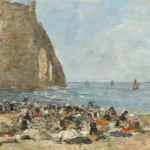
As if Étretat’s transformation into a fashionable seaside resort had never happened: Eugène Boudin (1824–1898), a pupil of Eugène Isabey and Claude Monet’s first mentor, stages his washerwomen in front of the Porte d’Aval, allowing them to blend picturesquely with the coastal landscape. Small fishing boats sail out to sea – Boudin ignores the tourist hustle and bustle of Étretat. Only the suggestion of a steamboat on the horizon alludes to the upheavals of the 19th century.
Monets Sea of Colors
Claude Monet was a witness to these momentous changes. The artist had known Normandy since childhood and was fascinated by the dramatic coastline throughout his life. He spent several extended periods in Étretat in the 1860s and 1880s, devoting more than 80 paintings to his impressions of nature along this stretch of coastline. The rock formations at Étretat inspired significant innovations in painting.
“I have remained faithful to my coast.”
An Artistic Calling
Claude Monet (1840–1926) spent his childhood in Le Havre, Normandy’s most important port city. The son of a food wholesaler, he decided at an early age to pursue a career as an artist – very much against his father’s wishes. At the age of 18, he met the painter Eugène Boudin, who became his mentor. With financial support from his aunt, Monet began studying art in Paris in 1860. Throughout his career, he regularly visited Normandy, painting landscapes en plein air. Monet’s international fame was slow in coming, and financial difficulties and uncertainties dogged him until the 1880s. It was not until his participation in the 1889 World’s Fair that Monet started enjoying increasing recognition and prosperity.

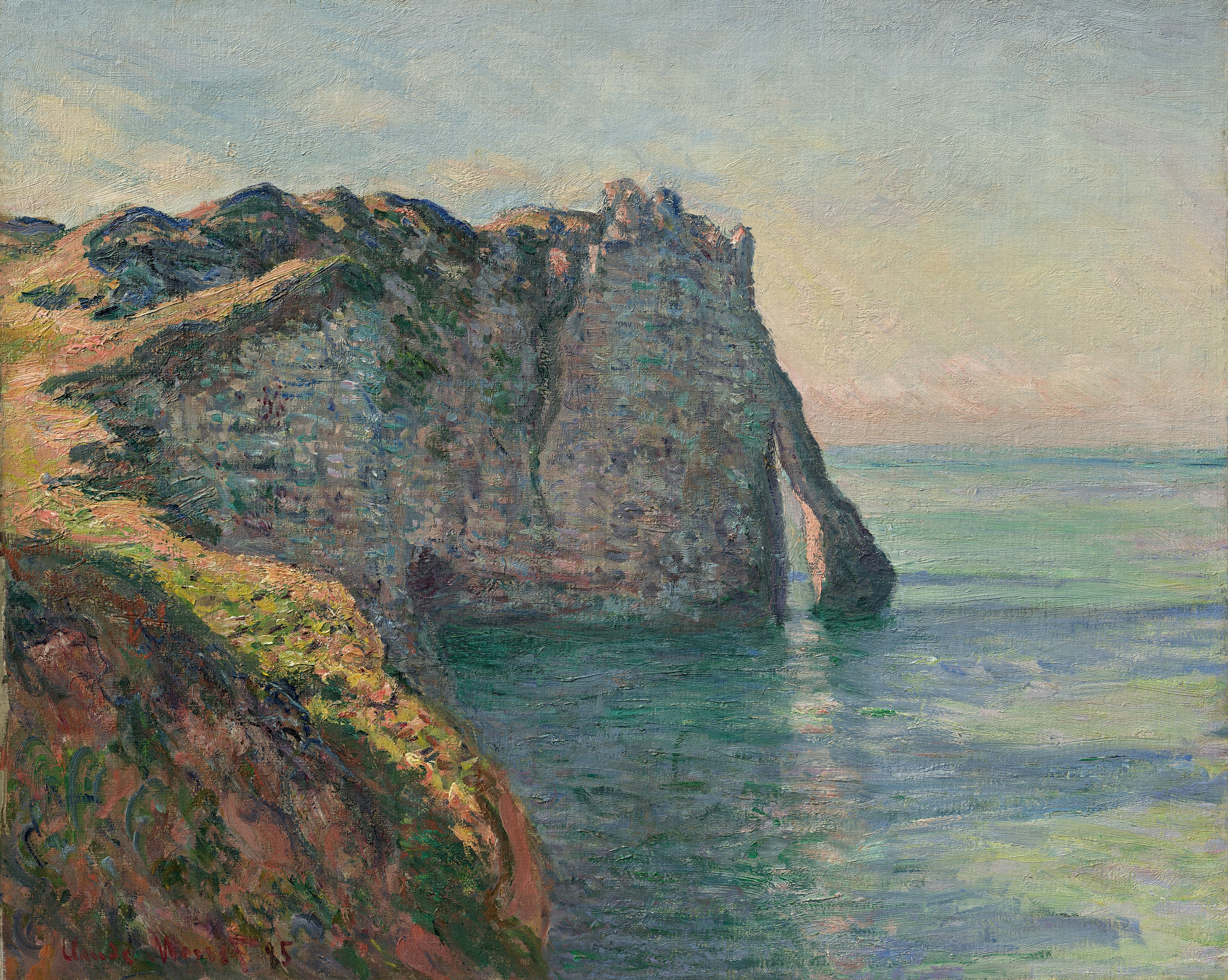
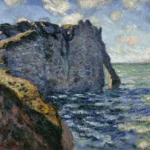
Today, Monet is world-famous for his Impressionist art-works. His 1885 painting The Cliffs of Aval exemplifies the distinctive characteristics of this revolutionary style of painting.
The sunlit rock, lapped by the waters of the Atlantic: the painting evokes the shimmering movement of the natural play of light and colour. The effect is achieved by means of short, discrete brushstrokes – known as taches (French for “spots”) – which are intentionally left visible on the canvas. Eschewing the use of contours and lines, Monet creates the forms of the landscape – the rocks, clouds and waves – solely from dabs of paint in contrasting colours.
“The Impressionist sees and paints nature as it is; that is, solely in vibrations of colour.”
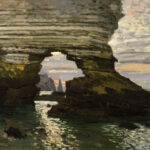
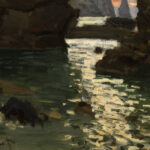
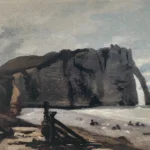
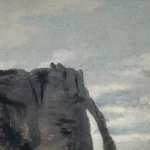
Every new painting style has to be invented: Monet began experimenting with the manner that would come to be called “Impressionist” during his second stay in Étretat. He avoided the height of the tourist season, choosing instead to go in the winter of 1868 and staying into the following year. His paintings of the majestic rock formations in the winter light herald his innovative handling of brush and paint.
Colour Theory
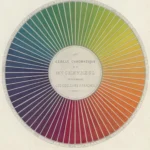
Red and green or blue and orange – strong colour contrasts feature prominently in the paintings by Monet and other Impressionists. In the mid-19th century, theorists and scientists began to study the laws governing colour. The writings of Eugène Chevreul, in particular, were widely read in Parisian artistic circles. The chemist had formulated a definition of what is known as complementary contrast. Each of the three primary colours – red, yellow and blue – is complementary to the mixture of the other two, thus creating a particularly strong, vibrant contrast for the human eye. Chevreul also described simultaneous contrasts: when two colours are seen directly next to each other, each appears altered by the other. Monet and his contemporaries drew on these theoretical findings in their choice of colours for their compositions.
“I’m surrounded here [in Étretat] by all that I love.”
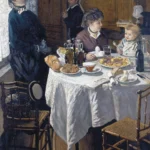
Throughout 1868, Monet was plagued by financial problems. Thanks to the support of a patron from Le Havre, he was able to afford accommodation in Étretat. During his stay, he painted not only the cliffs by the sea but also the then highly unconventional figure painting The Luncheon, which shows his own family gathered around a table. The large canvas is now a centrepiece of the Städel’s collection.
Bon appetit!
Potatoes and meat, salad, grapes and, of course, bread – a French lunch! But the bourgeois family idyll is deceptive: Monet, who was penniless, could barely provide for his companion Camille and their illegitimate son Jean. Constant changes of address and rejection by his father marked his life.
Monumental
An everyday scene measuring 2.30 x 1.50 metres! Monet deliberately broke with the academic rules of the 19th century, which stipulated that canvases of this size were the preserve of history painting – depictions of religious, mythological or historical events. A private family painting in such a large format was unusual and, for many, a deliberate provocation!
Enigmatic Newspaper
: A folded newspaper lies next to the place setting of the head of the family, the artist himself: the letters “LE FI” partly spell out the title Le Figaro, France’s oldest daily newspaper. At the same time, the letters may allude to the French word “le fils” – “the son”. Monet positions the newspaper so it appears to point to two-year-old Jean: a paternal acknowledgement of his illegitimate child!?
Empty chair
Who is supposed to sit here? The empty, pushed-back chair marks the place of the head of the family – the painter himself: his place setting is ready, the newspaper is within reach, his loved ones are gathered around the table. The autobiographical painting is constructed around a paradox: although Monet did not paint himself into the scene, the painting conveys his presence.
Illegitimate
Monet’s companion Camille Doncieux tenderly turns to little Jean, while behind her a maid closes a cupboard door. This seemingly carefree ménage was in reality a source of considerable stress: Claude and Camille’s son was born out of wedlock in 1867 – a disgrace in the 19th century! By law, a “bastard” had no claim to child support. Defying societal prejudices and his father’s persistent pressure, Monet did not disown his son and only married Camille a few months after completing this painting.
Visitor
A fitted jacket made of iridescent fabric, a neat bonnet with a face veil, and dark gloves: the woman is wearing an afternoon dress, which a lady would wear when out and about in town. Leaning against the window, the “visitor” in the family portrait reminds us of the relationship between outside and inside, public and private, society and the individual.
Gendered roles
Sitting on the chair is a basket with things in need of mending, beneath it lie a doll and a ball. While these everyday objects belong to the mother and child, the top hat, books and reading lamp on the console in the background on the right can be read as references to the father. Thus, the objects depicted in the painting reflect the traditional, gendered roles of family life. However, Monet’s lover Camille, his son Jean and his own role as a father did not conform to those bourgeois norms.
From Étretat to Paris: In 1870, Monet submitted The Luncheon to the jury of the official Paris Salon, the prestigious annual exhibition sponsored by the French government and the Académie des Beaux-Arts. It was rejected. Monet would not be able to present the painting publicly until 1874, when it was shown in the First Impressionist Exhibition in Paris. This alternative to the Salon, organised by Monet and his artist friends, gave their innovative style of painting a public platform.
Derided Impressionism
Derided Impressionism
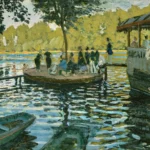
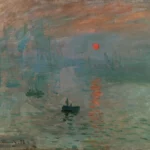
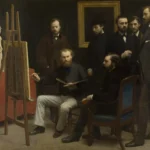
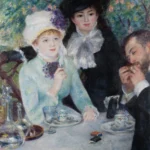
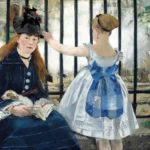
It was not only The Luncheon that failed to win over the jury of the Paris Salon; Monet’s first paintings in the Impressionist style were also rejected as too “unfinished” and unconventional. In fact, the term “Impressionism” was first used derisively: it was inadvertently coined by the art critic Louis Leroy (1812–1885) who drew on the title of Claude Monet’s painting Impression, Sunrise, which he had seen at the exhibition that has since come to be known as the First Impressionist Exhibition. The artists involved, who called themselves the Batignolles group, had gathered around the slightly older Edouard Manet (1832–1883) and hoped to develop a form of art that reflected the world they lived in. Their paintings were not only characterised by a new technique but also by unusual subjects: fleeting impressions of modern city life and leisure pursuits in a rapidly industrialising world.
“The Impressionist is therefore a modernist painter (…), who, forgetting his optical art school training – line, perspective, colour – has succeeded in remaking for himself a natural eye, and in seeing naturally and painting as simply as he sees.”
Roaring Waves
Modern forms of art and modern ways of rendering the coastal landscape: a few months after Monet had put his first Impressionist brushstrokes to canvas in Étretat, his friend Gustave Courbet (1819–1877), who would later act as Monet’s best man at his wedding to Camille, visited this unique spot on the Channel. Once again, Étretat inspired paintings that would go on to make art.
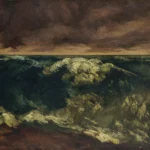
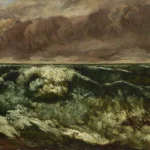
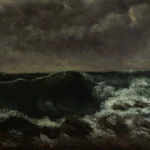
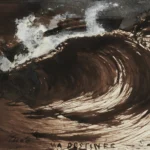
A huge, foaming wave breaking on the shore, with the vastness of the ocean behind it – in the summer of 1869, Gustave Courbet painted the first versions of his famous Wave paintings, allegedly during a raging storm in Étretat.
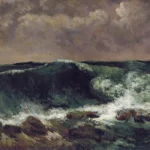
The towering wave is rolling directly towards the viewer. Crashing and foaming, it looks like it is about to break at the picture’s right-hand edge. Courbet’s contemporaries praised his Waves for their astounding force and recognised the bold audacity of his pictorial invention. The colourful, larger-than-life artist was notorious for his original ideas and knew how to create a public stir.
Courbet – Notorious
Gustave Courbet revolutionised painting – his paintings purposefully challenged traditional norms and viewing habits and would go on to influence generations of artists. Courbet’s conviction that art must spring from the individual vision and sensitivity of the artist is reflected in his distinctive landscapes. In his younger years an advocate of pictorial Realism, he committed to painting only what he could see: instead of heroes and saints, he depicted farm labourers and peasant women. Courbet also made headlines in political terms: shortly after his stay in Étretat, he took part in the Paris Commune, which rose up against the German occupiers and the rule of Emperor Napoleon III during the Franco-Prussian War of 1870. He was probably one of the instigators of the destruction of the victory column on the Place Vendôme in Paris – a symbol of the monarchy.
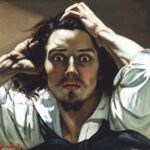
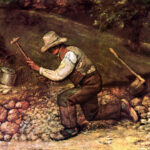
Today, numerous variations on the subject of the waves are on display in museums around the world. But these works raise questions: what deeper meaning lies behind these images of foaming sea water?
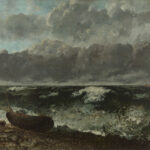
Waves from Far Away
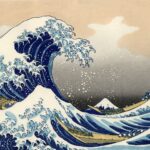
An imposing ocean wave as the central motif of a picture: Courbet may have found inspiration for this in Japan. He was probably familiar with the famous colour woodcut The Great Wave off Kanagawa by Katsushika Hokusai (1760–1849). In the mid-19th century, ukiyo-e prints – “pictures of the floating world” – began circulating in Paris and inspired many European artists. Starting in the 1860s, Claude Monet acquired hundreds of Japanese prints for his own collection.
“You may look in vain for a drop of water in this petrified ocean. If you took any portion of this picture (…) and showed it to anyone (…) he would take it for a piece of a wall.”
Fluidity and solidity rolled into one: Courbet’s waves can seem static, as if time and matter had been “frozen” by the artist’s hand. Courbet applied paint thickly using not only a brush but also a palette knife. His canvases are often encrusted with a thick, scab-like layer of paint.
Courbet’s wave paintings impressed Claude Monet. A few years after his friend’s death, Monet created his own series of paintings of rolling waves, responding to Courbet’s forceful intensity with Impressionist lightness. Contrasting shades of ochre and blue catch and delight the eye. Monet omits the beach and drift line, preferring instead to focus entirely on the movement of the surf and clouds, translating them to great effect into dynamic, sweeping brushstrokes.
Unfamiliar Painting Styles
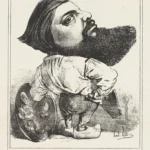
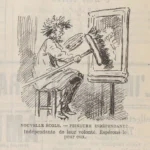
In the 19th century, Monet’s and Courbet’s convention-defying work truly made a splash. Their painting technique was at odds with the traditional use of paint and brushes. The press of the time responded with derisive caricatures. Courbet is depicted as an eccentric with a palette and a trowel, while Monet is portrayed as a muddle-headed painter attacking the canvas with a large broom. Many contemporary observers failed to grasp what the two artists were trying to achieve. Using oil paint with greater freedom, they sought to appeal directly to the viewer’s senses and invest their paintings with a new, contemporary vitality.
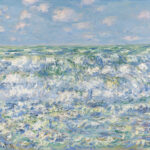
With his waves, Courbet had attempted something new – Monet followed suit. In his painting Waves Breaking of 1881, he transformed the motif of waves into a sea of vibrant brushstrokes in shades of blue, green and white. The rolling, foaming waves, which spill across the entire width of the canvas – and notionally beyond it – convey the incomprehensibility of incessant movement and boundlessness.
Howling of the Sea


Howling of the Sea
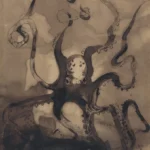
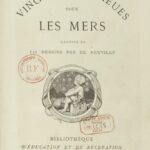
Whether as the setting for a story or as a metaphor for infinity and inner spiritual journeys, the sea was en vogue among French poets, writers and intellectuals in the 19th century. Jules Verne’s (1828–1905) adventure novel Twenty Thousand Leagues Under the Sea (1870) still enjoys widespread popularity. By the same token, Victor Hugo’s maritime poems and his novel Toilers of the Sea (1866) are considered classics of literary history. The Sea (1861) by the influential historian Jules Michelet (1798–1874) covers many aspects of what fascinated people about the sea at the time – from the physical properties of water and waves, the oceanic ecosystem, coastal populations and cultures, to the importance of the sea for our imagination.
“Modernity is the transitory, the fugitive, the contingent, that half of art of which the other is the eternal and immutable.”
Painting the Sea
Étretat continued to captivate Monet. Every year between 1883 and 1886, he was drawn to this unique coastal town. Initially, he was inspired by Gustave Courbet’s paintings, but increasingly he sought to capture his own ever-changing impressions, delineating the mighty rock arches rising from the waters of the Atlantic in one enthralling painting after another.
“I plan to do a large canvas of the cliff at Étretat, even if it is terribly audacious on my part to do that after Courbet did it so admirably, but I will try to do it differently.”
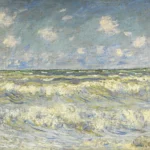
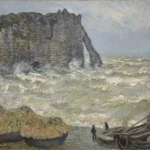
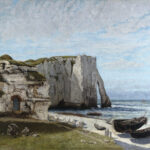
In the footsteps of Gustave Courbet: In 1883, six years after Courbet’s death, Monet painted Stormy Sea at Étretat, skilfully capturing the impression of white-capped, churning waves whipped up by a raging storm beneath a sallow sky.
Unfiltered Landscapes
Monet probably painted Stormy Sea at Étretat from the window of the Hôtel Blanquet. However, he worked on many of his paintings out of doors – en plein air – exposing himself to the vagaries of the wind, weather and light. By the mid-19th century, plein-air painting had become fashionable in France, reflecting many artists’ desire for authenticity and immediacy and their conviction that a painter’s sensory impressions should be transferred to canvas as directly as possible. These considerations also prompted reflection on the function of landscape art. The critic Champfleury (1821–1889), for example, argued that a ‘sincere’ image of nature could calm the overstimulated minds of city dwellers and help them escape the stress of modern life, at least for a moment: landscape art was “made for people who live in confinement”.
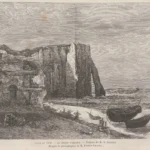
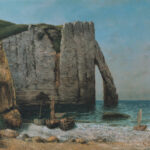
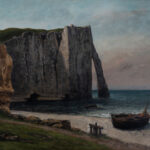
Monet had seen Courbet’s various depictions of the Porte d’Aval brought together for his posthumous retrospective exhibition in Paris in 1882. He adopted the motif of the boats at the lower right edge of the composition for his own painting of Rough Sea at Étretat. In the months and years that followed, Monet devoted a total of 17 further works to the view of the Aval rock formations – from different vantage points, under different weather and light conditions.
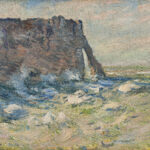
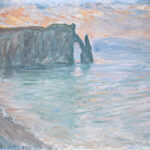
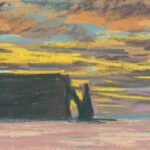
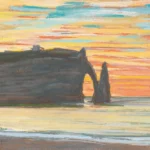
Monet pursued his ideas about Impressionist landscape painting with great commitment: his goal was to capture the visual impression of a unique, unrepeatable moment in time. A single image of a motif was never enough: numerous, varying representations captured the transient, ever-changing appearance of the landscape under different atmospheric conditions and at different times of the day or year – as well as reflecting the changing state of the artist’s mind.
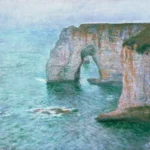
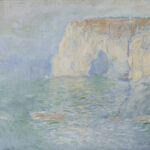
Subjective Vision
In the second half of the 19th century, ground-breaking research into the human sensory apparatus challenged the idea of there being any possibility of a stable perception of the visible world. The precursors of today’s neurosciences proved that certain patterns of perception are physiologically driven. Moreover, the brain always compares fresh visual stimuli with remembered images already imprinted in the mind and these can only ever be specific to each individual. Monet and many of his contemporaries took a keen interest in these findings. The realisation that there can be no single, purely objective impression of nature only confirmed their understanding of art and emboldened their artistic practice.

“To paint the sea really well, you need to look at it every hour of every day in the same place so that you can understand its ways in that particular spot (…).”
Monet’s Coast
Claude Monet’s paintings of the Étretat cliffs and rock arches are a feast for the eyes and invite us to linger. Imbued with a sense of a contemplative experience of nature, they reveal little of the obsessive, tireless effort Monet was prepared to put into the painting process.
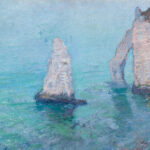
Flitting from moment to moment and place to place, Monet usually worked on several canvases simultaneously in Étretat. He would begin paintings on the beaches and rocks overlooking the bay and coastline, continue working on them, depending on his mood, the time of day and the weather, and often not complete them until weeks later in his studio.
“[He was] followed by children carrying five or six canvases representing the same subject at different times of the day and with different effects.”
Serial Painting
Monet’s obsessive way of working in Étretat—painting the same motif again and again across multiple canvases in ever-changing variations—anticipated the approach that would bring the Impressionist great acclaim from the 1890s onward. Confronted with subjects such as haystacks, the façade of Rouen Cathedral, and later the legendary water-lily pond in Giverny, Monet developed what would become a distinctly modern principle: serial painting. To this day, Monet’s “series” rank among the most famous works of art worldwide. Monet based his serial painting on the following principle: Each painting can be appreciated independently, yet it functions as an interchangeable object within the series. Only when the series is viewed as a whole the deeper artistic meaning and significance emerges.
In his quest for ever new visual impressions, the artist is said to have once nearly drowned when he was caught by the tide at the Manneporte after immersing himself in his work. His 1883 painting of the mighty rock arch seems to reflect that moment of overwhelming power: two tiny figures can be made out, dwarfed by the tumultuous roar of crashing waves and spray against the rockface.
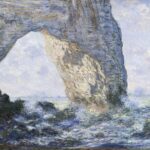
“It was a joy for me to see that sea in fury; it was like nervous exhaustion.”
The majestic Manneporte bathed in glistening light: Monet captured the cliffs to the south-west of Étretat under a wide range of atmospheric conditions. His determination to convey the fulness of his experience of nature through art sometimes brought him to the brink of exhaustion.
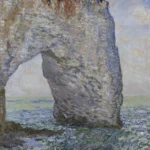
The visible world can never be fully captured or pinned down: this realisation lies at the heart of Monet’s art. While Romantic painters marvelled at the “natural wonders” of the cliffs of Étretat, Monet’s paintings revolve around the elusiveness and transience of appearance and perception. His seascapes invite viewers to immerse and lose themselves in them.
Claude Monet’s ravishing paintings of Étretat continue to fuel the myth surrounding this coastal village as one of the birthplaces of Impressionism. But artists working in other styles, too, found inspiration here. Throughout the 19th century, this spot on the Normandy coast and its eye-catching cliffs attracted numerous artists. Indeed, few other places document the revolution in painting as well as this.
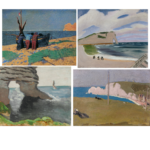
Eye Catcher
In the 20th century, too, Étretat remained a magnet for artists: Felix Vallotton (1865–1925), Henri Matisse (1869–1954), Maurice Denis (1870–1943) and many others captured its sights in their own distinctive visual languages. Their views of the bay of Étretat reflect changing perceptions of the character of coastal landscapes and art.