Coastal Paradise?
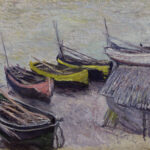
Old fishing boats on the beach act as a splash of colour against the turbid sea: Claude Monet’s Impressionist play of colours has lost none of its eye-catching power. At the same time, his painting Boats on the Beach at Étretat speaks to a sense of nostalgia that was widely felt in the 19th century. The rise of smoky industrial centres and rapidly expanding cities fuelled a desire to return to nature and a simpler, more authentic way of life. This, in turn, fuelled the popularity of places like Étretat, changing it from a remote fishing village and artists’ haunt into a fashionable seaside resort.
With a few dynamic brushstrokes, Monet also captures a strange kind of hut: it is a caloge, a decommissioned fishing boat converted into a thatched beach hut. The fishermen of Étretat used it to store their nets, buoys and ropes.
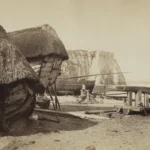
From makeshift utility hut to Normandy tourist attraction: in some places, caloges now serve as beach cafés. By the time Monet painted his Boats on the Beach at Étretat in 1883, these distinctive huts had already become recognised local landmarks for the swelling numbers of visitors to the coast around Étretat.
“Étretat is becoming more and more ravishing (…) the beach with all these fine boats is superb.”
Modern Tourism
Travelling purely for the sake of travelling and out of curiosity, with no professional purpose whatsoever: what may seem perfectly normal to us today only emerged as a social phenomenon in the 19th century. In 1872, Émile Littré’s landmark dictionary of the French language traced the term “touriste” back to the English tradition of the Grand Tour. This elite, educational rite of passage had brought young men of the British (and northern European) upper classes to the cultural centres of Europe since the 17th century and is indeed considered the precursor to modern tourism. In the 19th century, travel ceased to be the preserve of the aristocracy. It was democratised and became an emerging industry: the advent of the railways and steamships made health resorts, spas as well as scenic and cultural attractions more accessible. The English entrepreneur Thomas Cook (1808–1892) invented the package holiday. From the 1840s onwards, he offered complete travel packages to the English coast, France, Germany, Italy and even Egypt – all-inclusive for anyone with the time and money to spare.
Summer Resort
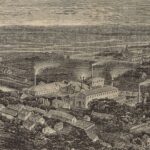
A remote fishing village comes into easy reach: in 1838, the first road leading to Étretat was constructed, followed a few years later by road connections from Fécamp in the north and Le Havre in the south, and in 1890 by a railway line from Paris. The face of Étretat gradually changed: summer villas sprung up, owned by wealthy city dwellers, and public seawater baths and a casino were built along the beach.
“Since 1820, when Isabey began to explore Étretat (…), they have been coming in their hundreds every summer.”
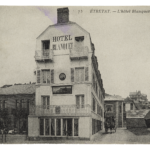
Hôtel Blanquet, the oldest inn in the village, had long been considered an insider tip among artists and writers. By the mid-19th century, it was dubbed “Au Rendezvous des Artistes” and became popular with summer visitors as well. In 1842 – as the village was beginning to change – the successful Parisian painter Eugène Le Poittevin (1806–1870) painted a wooden sign for the hotel’s façade.
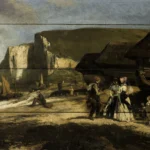
The chalk cliffs form the backdrop to the bustle of fishermen on the beach. Also featured are the distinctive caloges and an artist sketching as he gazes out to sea. In the foreground of the wooden sign, two elaborately dressed townswomen attest to the dawn of tourism. Le Poittevin’s sign advertises what summer visitors to Étretat could expect: the beach, the cliffs and encounters with the local villagers.
Eugène Le Poittevin
Eugène Le Poittevin (1806–1870) may be largely forgotten today, but during his lifetime he was one of the best-known artists in Paris. Having studied at the renowned École des Beaux Arts, he enjoyed considerable success at the Salon, the academy’s annual exhibition platform. A painter of large marines – scenes of naval battles and coastal landscapes – Le Poittevin also worked as a lithographer and caricaturist, gaining notoriety for his erotic and political satires. In 1849, he became one of the first urbanites to acquire a plot of land in Étretat, at the Porte d’Aval, where he built a house and studio. In his villa “La Chaufferette” (the brazier), built in 1858 in the village centre, he became a generous host to artists, writers, actors and composers visiting Étretat.
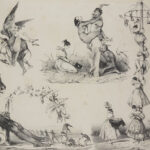
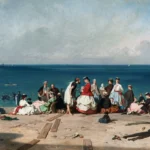
Eugène Le Poittevin spent a great deal of time in Étretat and was friends with the local population. A keen observer of the village’s transformation, he captured the activities of summer visitors on the beach with subtle irony in a large painting completed in 1864.
A Day by the Sea
A portrait of society: summer visitors in elegant attire! Approaching his subject with a touch of humour, Le Poittevin captures women embroidering and reading, men gesticulating, and children playing. Even the pooches of the Parisian elite seem to be enjoying the fresh sea air and deep-blue water. In 1864, when the painting was created, the number of summer visitors to Étretat had already increased rapidly – the 1,500 permanent residents were now joined every year by approximately 4,000–5,000 guests.
Swimming Writer
The young man in a bathing suit is probably Guy de Maupassant (1850–1893), who would become one of the most renowned French writers of the 19th century. Born in a chateau in Normandy, Maupassant spent his summers in Étretat with his mother and is said to have been a very good swimmer. The painter depicts the athletic 14-year-old in lively conversation with two summer visitors.
Bathing Service
On the far right of the painting, Le Poittevin depicts the Étretat swimming baths. In front of the changing cabins, a self-conscious bather is intent on rushing past a woman carrying a flat basket. The artist stages a clash between two worlds: the encounters between an urbanite summer guest and a villager. The woman’s tanned, weather-beaten skin betrays her hard physical labour in the open air.
Take a Dip!
City dwellers are braving the sea! What we now take for granted as one of the pleasures of summer was new and exciting in the 19th century. Bathing in the cold waters of the Atlantic Ocean initially served medical purposes and was prescribed by doctors as a cure for various ailments. But people soon discovered their enthusiasm for bathing for its own sake: Le Poittevin’s painting shows the bourgeoisie frolicking merrily in the water. Bathing attendants and boatmen ensure the safety and comfort of the summer visitors.
Belching Steamboat
Heavy, grey clouds of smoke on the horizon – a mighty steamship ploughs through the English Channel. With this detail, the painter reminds us of the dramatic changes of his time: industrialisation and its technological innovations did not stop at the coastline. In 1838, the French navy began replacing all its sailing ships with steamships.
Who’s Who
A few of the faces in the panorama of beachgoers are recognisable portraits: the man reading a newspaper with a dog at his feet is Charles Albert d’Arnoux (1820–1882), an aristocrat, caricaturist and pioneering photographer and an acquaintance of Le Poittevin. Étretat attracted several celebrated creative minds, among them the writers Victor Hugo (1802–1885), Alexandre Dumas (1802–1870), Gustave Flaubert (1821–1880), the composer Jacques Offenbach (1819–1880), the actress Eugénie Doche (1821–1900) and the operatic baritone Jean-Baptiste Faure (1830–1914).
Fishing Gear
A fishing net, a buoy and a woven basket – the objects in the foreground of the beach panorama reveal more than meets the eye: the fishermen’s everyday tools counterbalance the children’s toys and the heap of casually strewn clothes of the summer guests. The artist highlights the social disparities that modern tourism throws into sharp relief, with abundance, leisure and financial clout colliding with archaic simplicity, physically demanding labour and poverty.
SEA BATHING
The third seaside resort in France! Following the first seaside swimming baths in Dieppe and Trouville further along the coast, the Bains Duchemin opened in Étretat in 1843–1844. From Normandy, the model of sea bathing would soon spread to other coastal regions of France. Initially, saltwater bathing served therapeutic purposes: in English coastal towns such as Brighton and Scarborough, patients had already started taking to the chilly waters in the 18th century. These bathing cures were based on the miasma theory – the medical belief that diseases were caused by noxious air or foul vapours. Cold sea water was thought to have healing properties. In the second half of the 19th century, the miasma theory fell out of favour, and sea bathing gradually became a popular leisure activity.
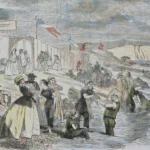
“[The women brought] utter chaos to the quiet life of Étretat. They made the pebbles tremble beneath the frou-frou [rustle] of their dresses.”
Étretat Through the Camera Lens
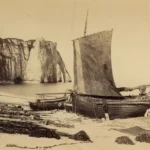

Étretat Through the Camera Lens
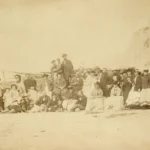
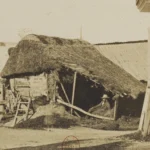
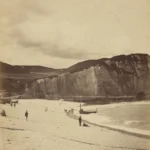
Today, holiday photos are taken digitally, with little forethought or effort. In the mid-19th century, however, analogue photography was barely a few decades old and not many people could claim to have mastered its technical challenges. The new technology arrived in Étretat in the 1850s. Wealthy visitors took numerous photographs of their summer resort, capturing holidaymakers and boats on the beach, traditional fishermen’s huts, the cliffs and the village. Amateur photographers such as Paul Gaillard (1832–1890) and the chemist Alphonse Davanne (1824–1912) created entire series of images and were founding members of the Société française de photographie in 1854, the world’s first photographic club.
A profound change: the local population of Étretat adapted to the needs of summer visitors. People who had been fishermen, weavers or merchant-navy sailors at the beginning of the 19th century took to working as domestic servants, gardeners or bathing attendants. But visitors to Étretat continued to harbour a nostalgic dream of “untouched” nature and a traditional existence living off the sea and the land.
The Dream of Untouched Authenticity
Despite all the changes, Étretat’s image as a remote, unspoilt coastal village remains intact. Ever since the area was first discovered by artists, the fishermen and villagers in particular have served as a blank canvas for the projected fantasies and hackneyed ideas of city dwellers.
“In Étretat, everything has a strangeness that forcefully strikes the imagination.”
A village and its inhabitants, far away from modern society: Eugène Isabey didn’t just paint the breathtaking coastline of Étretat. His painting Beach at Low Tide of 1833 is marked by Romanticism’s desire for a simple life spent in harmony with nature. It shows the houses and people of the village before it was spoiled by tourism.
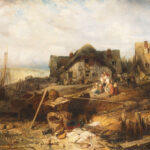
Family Idyll?
A poor fisherman’s closely knit family of many children, dressed in simple clothes, bathed in a soft light: the painting conveys a touching, if idealised image of a close community “uncorrupted” by modern industrial life. For locals, life in Étretat could be very harsh indeed: hunger and regular floodings that buried the village in mud were part of the struggle for survival.
Thatched
Wind-swept, thatched half-timbered cottages stand close together, straw projects from the windows, and everyday objects lean against the walls. Although Isabey’s painting hints at the harsh poverty of the fishermen, it is infused with a dreamy longing for cosy homeliness. In reality, the old thatched cottages of Étretat were built close to ground level, their walls made of hewn flint.
On the Ground
Baskets, old fishing gear and a pile of freshly caught rays lie scattered haphazardly across the rocky beach: this detail of the painting alludes to the idea of the “uncivilised”, down-to-earth nature of the fisherman’s existence. The sophisticated city dwellers’ view of the simplicity of coastal life fluctuated between romanticisation and disdain. The viewers and buyers of this picture could feast their eyes on it and still feel aloof from the life it captures.
Life in Poverty
It was not only visual artists who captured the life of Étretat’s longtime residents. Writers also took an interest in the circumstances of the fishermen and cottage workers in the coastal village. Besides Eugène Isabey, Alphonse Karr (1808–1890) played a key role in raising Étretat’s profile. In 1850 he published his Histoire de Rose et de Jean Duchemin, a diary-like account of a cottage labourer and fisherman’s wife from Étretat. The book reveals a life marked by hardship, poverty and deep piety – and no less than sixteen hungry children whose stomachs were forever rumbling.
Long after tourism had arrived, Eugène Le Poittevin painted numerous pictures of the fishermen of the coastal community. The paintings depict hard-working people marked by poverty, set against the breathtaking natural spectacle of the cliffs of Étretat.
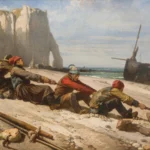
Four fishermen in patched clothing are dragging a boat onto the beach. In the background, another group of men are pulling with all their might on a capstan winch to haul an even heavier boat out of the water. The artist paints the fishermen of Étretat as faceless figures: only the man with the blue, white and red cap in the foreground shows his face, deeply furrowed by exertion and constant exposure to the elements. Like Le Poittevin’s panoramas of summer visitors on the beach, his paintings of fishermen contain a hint of social critique.
Red Caps
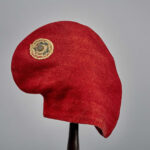
Fishermen close to the shore or farther out, foraging for shellfish at low tide – in all his paintings, Le Poittevin depicts men wearing striking red caps. Such caps were part of the traditional costume of fishermen from nearby Dieppe. At the same time, they would have reminded contemporary viewers of one of the most potent political symbols of 18th- and 19th-century France: the bonnet rouge, or Phrygian cap. During the French Revolution, this cap – mistakenly believed to be the headwear of freed slaves in antiquity – became a symbol of liberty and democratic ideals. Le Poittevin’s paintings were created under Napoleon III. He had proclaimed himself Emperor of the French after a coup d’état in 1852 and put an end to France’s fledgling republican constitution until the collapse of the Second Empire in 1870.
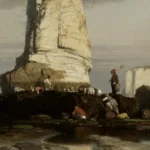
Tourism reveals social divisions: around 1860, the beach of Étretat was divided into two. The northern section, with its beach promenade lined with villas and the casino, was strictly reserved for bathers. The southern section, facing the Aval cliffs, remained the domain of fishermen and washerwomen and was known by the derisive name Perrey des Manants (“pebble dump of the simpletons”).
“Étretat languishes (…). This brush with Paris, fashionable Paris, however well it pays, is a scourge on the land.”
A seductive image of a beautiful young woman: in 1869, the Parisian artist Hugues Merle (1822–1881) portrayed a laundress in front of the iconic Porte d’Aval – at first glance, a Romantic, sumptuous painting that reinforces the clichéd image of Étretat’s unspoilt nature. But on closer inspection, the laundress’s slight frown betrays the drudgery of her existence, from which there is no escape. The hard-working older women in the background seem to presage her future fate.
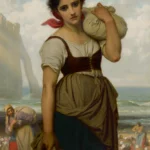
Washerwomen on the Beach
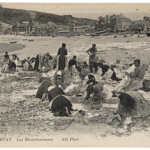
Washing laundry on the beach? In Étretat, this had been common practice for centuries: at low tide, freshwater springs are exposed beneath the pebble beach and allow for the washing of clothing and linens. Embodying the supposedly unspoilt authenticity of the place, the washerwomen of Étretat remained a popular motif among artists and the producers of picture postcards for decades.
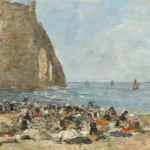
As if Étretat’s transformation into a fashionable seaside resort had never happened: Eugène Boudin (1824–1898), a pupil of Eugène Isabey and Claude Monet’s first mentor, stages his washerwomen in front of the Porte d’Aval, allowing them to blend picturesquely with the coastal landscape. Small fishing boats sail out to sea – Boudin ignores the tourist hustle and bustle of Étretat. Only the suggestion of a steamboat on the horizon alludes to the upheavals of the 19th century.