Painting the Sea
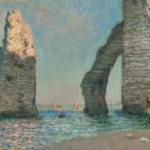
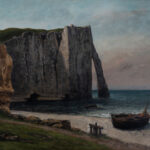
Étretat continued to captivate Monet. Every year between 1883 and 1886, he was drawn to this unique coastal town. Initially, he was inspired by Gustave Courbet’s paintings, but increasingly he sought to capture his own ever-changing impressions, delineating the mighty rock arches rising from the waters of the Atlantic in one enthralling painting after another.
“I plan to do a large canvas of the cliff at Étretat, even if it is terribly audacious on my part to do that after Courbet did it so admirably, but I will try to do it differently.”
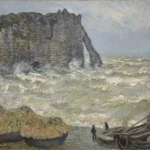
In the footsteps of Gustave Courbet: In 1883, six years after Courbet’s death, Monet painted Stormy Sea at Étretat, skilfully capturing the impression of white-capped, churning waves whipped up by a raging storm beneath a sallow sky.
Unfiltered Landscapes
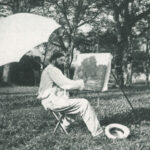
Monet probably painted Stormy Sea at Étretat from the window of the Hôtel Blanquet. However, he worked on many of his paintings out of doors – en plein air – exposing himself to the vagaries of the wind, weather and light. By the mid-19th century, plein-air painting had become fashionable in France, reflecting many artists’ desire for authenticity and immediacy and their conviction that a painter’s sensory impressions should be transferred to canvas as directly as possible. These considerations also prompted reflection on the function of landscape art. The critic Champfleury (1821–1889), for example, argued that a ‘sincere’ image of nature could calm the overstimulated minds of city dwellers and help them escape the stress of modern life, at least for a moment: landscape art was “made for people who live in confinement”.

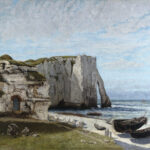
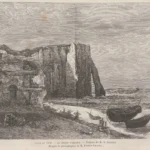
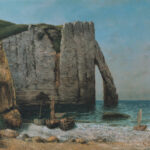
Monet had seen Courbet’s various depictions of the Porte d’Aval brought together for his posthumous retrospective exhibition in Paris in 1882. He adopted the motif of the boats at the lower right edge of the composition for his own painting of Rough Sea at Étretat. In the months and years that followed, Monet devoted a total of 17 further works to the view of the Aval rock formations – from different vantage points, under different weather and light conditions.
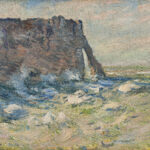
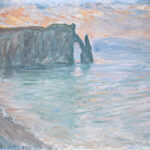

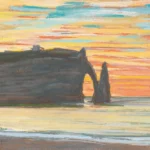
Monet pursued his ideas about Impressionist landscape painting with great commitment: his goal was to capture the visual impression of a unique, unrepeatable moment in time. A single image of a motif was never enough: numerous, varying representations captured the transient, ever-changing appearance of the landscape under different atmospheric conditions and at different times of the day or year – as well as reflecting the changing state of the artist’s mind.
Subjective Vision
In the second half of the 19th century, ground-breaking research into the human sensory apparatus challenged the idea of there being any possibility of a stable perception of the visible world. The precursors of today’s neurosciences proved that certain patterns of perception are physiologically driven. Moreover, the brain always compares fresh visual stimuli with remembered images already imprinted in the mind and these can only ever be specific to each individual. Monet and many of his contemporaries took a keen interest in these findings. The realisation that there can be no single, purely objective impression of nature only confirmed their understanding of art and emboldened their artistic practice.

“To paint the sea really well, you need to look at it every hour of every day in the same place so that you can understand its ways in that particular spot (…).”
Monet’s Coast
Claude Monet’s paintings of the Étretat cliffs and rock arches are a feast for the eyes and invite us to linger. Imbued with a sense of a contemplative experience of nature, they reveal little of the obsessive, tireless effort Monet was prepared to put into the painting process.
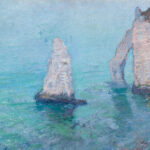
Flitting from moment to moment and place to place, Monet usually worked on several canvases simultaneously in Étretat. He would begin paintings on the beaches and rocks overlooking the bay and coastline, continue working on them, depending on his mood, the time of day and the weather, and often not complete them until weeks later in his studio.
“[He was] followed by children carrying five or six canvases representing the same subject at different times of the day and with different effects.”
Serial Painting
Monet’s obsessive way of working in Étretat—painting the same motif again and again across multiple canvases in ever-changing variations—anticipated the approach that would bring the Impressionist great acclaim from the 1890s onward. Confronted with subjects such as haystacks, the façade of Rouen Cathedral, and later the legendary water-lily pond in Giverny, Monet developed what would become a distinctly modern principle: serial painting. To this day, Monet’s “series” rank among the most famous works of art worldwide. Monet based his serial painting on the following principle: Each painting can be appreciated independently, yet it functions as an interchangeable object within the series. Only when the series is viewed as a whole the deeper artistic meaning and significance emerges.
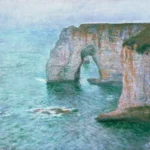
In his quest for ever new visual impressions, the artist is said to have once nearly drowned when he was caught by the tide at the Manneporte after immersing himself in his work. His 1883 painting of the mighty rock arch seems to reflect that moment of overwhelming power: two tiny figures can be made out, dwarfed by the tumultuous roar of crashing waves and spray against the rockface.
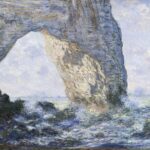
“It was a joy for me to see that sea in fury; it was like nervous exhaustion.”
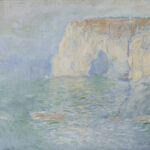
The majestic Manneporte bathed in glistening light: Monet captured the cliffs to the south-west of Étretat under a wide range of atmospheric conditions. His determination to convey the fulness of his experience of nature through art sometimes brought him to the brink of exhaustion.
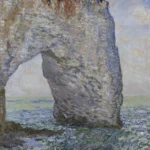
The visible world can never be fully captured or pinned down: this realisation lies at the heart of Monet’s art. While Romantic painters marvelled at the “natural wonders” of the cliffs of Étretat, Monet’s paintings revolve around the elusiveness and transience of appearance and perception. His seascapes invite viewers to immerse and lose themselves in them.
Claude Monet’s ravishing paintings of Étretat continue to fuel the myth surrounding this coastal village as one of the birthplaces of Impressionism. But artists working in other styles, too, found inspiration here. Throughout the 19th century, this spot on the Normandy coast and its eye-catching cliffs attracted numerous artists. Indeed, few other places document the revolution in painting as well as this.