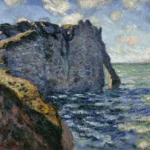
Monets Sea of Colors
Claude Monet was a witness to these momentous changes. The artist had known Normandy since childhood and was fascinated by the dramatic coastline throughout his life. He spent several extended periods in Étretat in the 1860s and 1880s, devoting more than 80 paintings to his impressions of nature along this stretch of coastline. The rock formations at Étretat inspired significant innovations in painting.
“I have remained faithful to my coast.”
An Artistic Calling
Claude Monet (1840–1926) spent his childhood in Le Havre, Normandy’s most important port city. The son of a food wholesaler, he decided at an early age to pursue a career as an artist – very much against his father’s wishes. At the age of 18, he met the painter Eugène Boudin, who became his mentor. With financial support from his aunt, Monet began studying art in Paris in 1860. Throughout his career, he regularly visited Normandy, painting landscapes en plein air. Monet’s international fame was slow in coming, and financial difficulties and uncertainties dogged him until the 1880s. It was not until his participation in the 1889 World’s Fair that Monet started enjoying increasing recognition and prosperity.

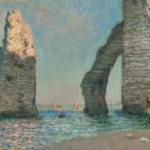
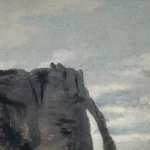
Today, Monet is world-famous for his Impressionist art-works. His 1885 painting The Cliffs of Aval exemplifies the distinctive characteristics of this revolutionary style of painting.
The sunlit rock, lapped by the waters of the Atlantic: the painting evokes the shimmering movement of the natural play of light and colour. The effect is achieved by means of short, discrete brushstrokes – known as taches (French for “spots”) – which are intentionally left visible on the canvas. Eschewing the use of contours and lines, Monet creates the forms of the landscape – the rocks, clouds and waves – solely from dabs of paint in contrasting colours.
“The Impressionist sees and paints nature as it is; that is, solely in vibrations of colour.”
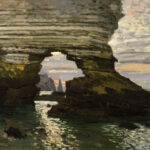
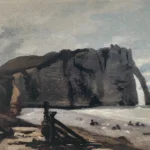
Every new painting style has to be invented: Monet began experimenting with the manner that would come to be called “Impressionist” during his second stay in Étretat. He avoided the height of the tourist season, choosing instead to go in the winter of 1868 and staying into the following year. His paintings of the majestic rock formations in the winter light herald his innovative handling of brush and paint.
Colour Theory
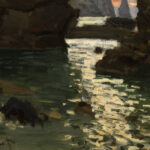
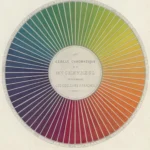
Red and green or blue and orange – strong colour contrasts feature prominently in the paintings by Monet and other Impressionists. In the mid-19th century, theorists and scientists began to study the laws governing colour. The writings of Eugène Chevreul, in particular, were widely read in Parisian artistic circles. The chemist had formulated a definition of what is known as complementary contrast. Each of the three primary colours – red, yellow and blue – is complementary to the mixture of the other two, thus creating a particularly strong, vibrant contrast for the human eye. Chevreul also described simultaneous contrasts: when two colours are seen directly next to each other, each appears altered by the other. Monet and his contemporaries drew on these theoretical findings in their choice of colours for their compositions.
“I’m surrounded here [in Étretat] by all that I love.”
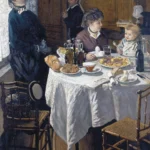
Throughout 1868, Monet was plagued by financial problems. Thanks to the support of a patron from Le Havre, he was able to afford accommodation in Étretat. During his stay, he painted not only the cliffs by the sea but also the then highly unconventional figure painting The Luncheon, which shows his own family gathered around a table. The large canvas is now a centrepiece of the Städel’s collection.
Bon appetit!
Potatoes and meat, salad, grapes and, of course, bread – a French lunch! But the bourgeois family idyll is deceptive: Monet, who was penniless, could barely provide for his companion Camille and their illegitimate son Jean. Constant changes of address and rejection by his father marked his life.
Monumental
An everyday scene measuring 2.30 x 1.50 metres! Monet deliberately broke with the academic rules of the 19th century, which stipulated that canvases of this size were the preserve of history painting – depictions of religious, mythological or historical events. A private family painting in such a large format was unusual and, for many, a deliberate provocation!
Enigmatic Newspaper
: A folded newspaper lies next to the place setting of the head of the family, the artist himself: the letters “LE FI” partly spell out the title Le Figaro, France’s oldest daily newspaper. At the same time, the letters may allude to the French word “le fils” – “the son”. Monet positions the newspaper so it appears to point to two-year-old Jean: a paternal acknowledgement of his illegitimate child!?
Empty chair
Who is supposed to sit here? The empty, pushed-back chair marks the place of the head of the family – the painter himself: his place setting is ready, the newspaper is within reach, his loved ones are gathered around the table. The autobiographical painting is constructed around a paradox: although Monet did not paint himself into the scene, the painting conveys his presence.
Illegitimate
Monet’s companion Camille Doncieux tenderly turns to little Jean, while behind her a maid closes a cupboard door. This seemingly carefree ménage was in reality a source of considerable stress: Claude and Camille’s son was born out of wedlock in 1867 – a disgrace in the 19th century! By law, a “bastard” had no claim to child support. Defying societal prejudices and his father’s persistent pressure, Monet did not disown his son and only married Camille a few months after completing this painting.
Visitor
A fitted jacket made of iridescent fabric, a neat bonnet with a face veil, and dark gloves: the woman is wearing an afternoon dress, which a lady would wear when out and about in town. Leaning against the window, the “visitor” in the family portrait reminds us of the relationship between outside and inside, public and private, society and the individual.
Gendered roles
Sitting on the chair is a basket with things in need of mending, beneath it lie a doll and a ball. While these everyday objects belong to the mother and child, the top hat, books and reading lamp on the console in the background on the right can be read as references to the father. Thus, the objects depicted in the painting reflect the traditional, gendered roles of family life. However, Monet’s lover Camille, his son Jean and his own role as a father did not conform to those bourgeois norms.
From Étretat to Paris: In 1870, Monet submitted The Luncheon to the jury of the official Paris Salon, the prestigious annual exhibition sponsored by the French government and the Académie des Beaux-Arts. It was rejected. Monet would not be able to present the painting publicly until 1874, when it was shown in the First Impressionist Exhibition in Paris. This alternative to the Salon, organised by Monet and his artist friends, gave their innovative style of painting a public platform.
Derided Impressionism
Derided Impressionism
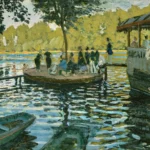
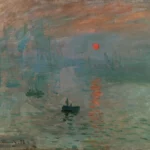
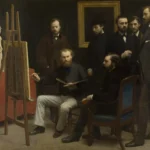
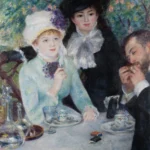
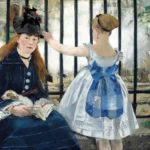
It was not only The Luncheon that failed to win over the jury of the Paris Salon; Monet’s first paintings in the Impressionist style were also rejected as too “unfinished” and unconventional. In fact, the term “Impressionism” was first used derisively: it was inadvertently coined by the art critic Louis Leroy (1812–1885) who drew on the title of Claude Monet’s painting Impression, Sunrise, which he had seen at the exhibition that has since come to be known as the First Impressionist Exhibition. The artists involved, who called themselves the Batignolles group, had gathered around the slightly older Edouard Manet (1832–1883) and hoped to develop a form of art that reflected the world they lived in. Their paintings were not only characterised by a new technique but also by unusual subjects: fleeting impressions of modern city life and leisure pursuits in a rapidly industrialising world.
“The Impressionist is therefore a modernist painter (…), who, forgetting his optical art school training – line, perspective, colour – has succeeded in remaking for himself a natural eye, and in seeing naturally and painting as simply as he sees.”
Roaring Waves
Modern forms of art and modern ways of rendering the coastal landscape: a few months after Monet had put his first Impressionist brushstrokes to canvas in Étretat, his friend Gustave Courbet (1819–1877), who would later act as Monet’s best man at his wedding to Camille, visited this unique spot on the Channel. Once again, Étretat inspired paintings that would go on to make art.
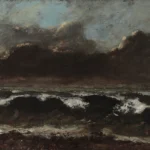
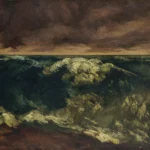
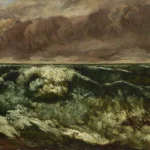
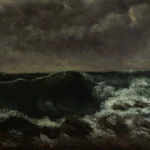
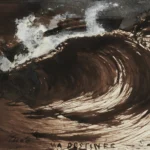
A huge, foaming wave breaking on the shore, with the vastness of the ocean behind it – in the summer of 1869, Gustave Courbet painted the first versions of his famous Wave paintings, allegedly during a raging storm in Étretat.
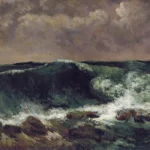
The towering wave is rolling directly towards the viewer. Crashing and foaming, it looks like it is about to break at the picture’s right-hand edge. Courbet’s contemporaries praised his Waves for their astounding force and recognised the bold audacity of his pictorial invention. The colourful, larger-than-life artist was notorious for his original ideas and knew how to create a public stir.
Courbet – Notorious
Gustave Courbet revolutionised painting – his paintings purposefully challenged traditional norms and viewing habits and would go on to influence generations of artists. Courbet’s conviction that art must spring from the individual vision and sensitivity of the artist is reflected in his distinctive landscapes. In his younger years an advocate of pictorial Realism, he committed to painting only what he could see: instead of heroes and saints, he depicted farm labourers and peasant women. Courbet also made headlines in political terms: shortly after his stay in Étretat, he took part in the Paris Commune, which rose up against the German occupiers and the rule of Emperor Napoleon III during the Franco-Prussian War of 1870. He was probably one of the instigators of the destruction of the victory column on the Place Vendôme in Paris – a symbol of the monarchy.
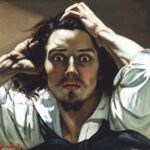
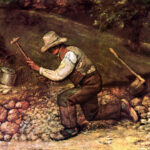
Today, numerous variations on the subject of the waves are on display in museums around the world. But these works raise questions: what deeper meaning lies behind these images of foaming sea water?
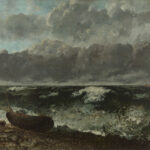
Waves from Far Away
An imposing ocean wave as the central motif of a picture: Courbet may have found inspiration for this in Japan. He was probably familiar with the famous colour woodcut The Great Wave off Kanagawa by Katsushika Hokusai (1760–1849). In the mid-19th century, ukiyo-e prints – “pictures of the floating world” – began circulating in Paris and inspired many European artists. Starting in the 1860s, Claude Monet acquired hundreds of Japanese prints for his own collection.
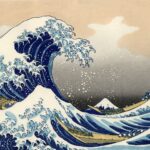
“You may look in vain for a drop of water in this petrified ocean. If you took any portion of this picture (…) and showed it to anyone (…) he would take it for a piece of a wall.”
Fluidity and solidity rolled into one: Courbet’s waves can seem static, as if time and matter had been “frozen” by the artist’s hand. Courbet applied paint thickly using not only a brush but also a palette knife. His canvases are often encrusted with a thick, scab-like layer of paint.
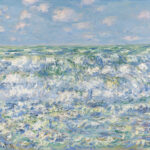
Courbet’s wave paintings impressed Claude Monet. A few years after his friend’s death, Monet created his own series of paintings of rolling waves, responding to Courbet’s forceful intensity with Impressionist lightness. Contrasting shades of ochre and blue catch and delight the eye. Monet omits the beach and drift line, preferring instead to focus entirely on the movement of the surf and clouds, translating them to great effect into dynamic, sweeping brushstrokes.
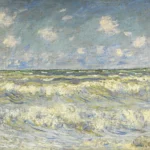
Unfamiliar Painting Styles
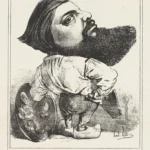
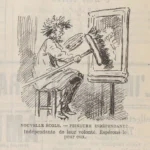
In the 19th century, Monet’s and Courbet’s convention-defying work truly made a splash. Their painting technique was at odds with the traditional use of paint and brushes. The press of the time responded with derisive caricatures. Courbet is depicted as an eccentric with a palette and a trowel, while Monet is portrayed as a muddle-headed painter attacking the canvas with a large broom. Many contemporary observers failed to grasp what the two artists were trying to achieve. Using oil paint with greater freedom, they sought to appeal directly to the viewer’s senses and invest their paintings with a new, contemporary vitality.
With his waves, Courbet had attempted something new – Monet followed suit. In his painting Waves Breaking of 1881, he transformed the motif of waves into a sea of vibrant brushstrokes in shades of blue, green and white. The rolling, foaming waves, which spill across the entire width of the canvas – and notionally beyond it – convey the incomprehensibility of incessant movement and boundlessness.
Howling of the Sea


Howling of the Sea
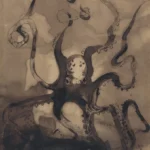
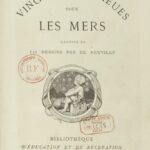
Whether as the setting for a story or as a metaphor for infinity and inner spiritual journeys, the sea was en vogue among French poets, writers and intellectuals in the 19th century. Jules Verne’s (1828–1905) adventure novel Twenty Thousand Leagues Under the Sea (1870) still enjoys widespread popularity. By the same token, Victor Hugo’s maritime poems and his novel Toilers of the Sea (1866) are considered classics of literary history. The Sea (1861) by the influential historian Jules Michelet (1798–1874) covers many aspects of what fascinated people about the sea at the time – from the physical properties of water and waves, the oceanic ecosystem, coastal populations and cultures, to the importance of the sea for our imagination.
“Modernity is the transitory, the fugitive, the contingent, that half of art of which the other is the eternal and immutable.”